
This article is about character spacing. For information on tracking animals see our sister company SignOfPassageAgent.
Tracking
Tracking - the uniform adjustment of the horizontal space between all characters.
There are two ways to specify tracking. First through Illustrator settings and secondly through Bounding Box commands. The first is more familiar to existing users of Illustrator and the second allows for extra flexibility.
1. Illustrator Settings
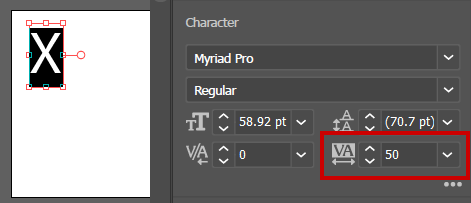
-
- Open the Character Panel (Type > Character)
- Select the text you'd like to adjust the tracking on.
- Adjust the tracking until you're happy with the appearance.
NOTES
-
- The kerning for all text must be set to 0 for tracking to be properly implemented
- Your text must be a "true" size for tracking to work. In other words, avoid "stretching" your text to resize it - if you want to change your font size, always use the pt panel and enter the numbers in manually, and as best practise, use point text instead of area text in Illustrator.
2. Bounding Box Command
Tracking, like any command, is added somewhere after the justification commands in the bounding box. It is structured:
tracking: distance
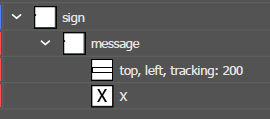
No Units
The default unit in Illustrator is an "em". Tracking is measured in thousandths of an em. This follows the same measurement logic as specifying the tracking directly through Illustrator's interface.
tracking: -50 will shrink the spacing between characters from the default.
tracking: 100 will increase the spacing between characters from the default.
Units
Adding units to the command will allow for space between characters measured in other standard units. Accepted units are mm, pt, in, px.
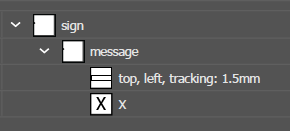
Optical Kerning
Optical Kerning - Calculates the spacing between consecutive letter pairs based on their physical shapes rather than using pre-programmed values.
1. Ensure the kerning for any text is set to "0" rather than "Auto" or any other value.
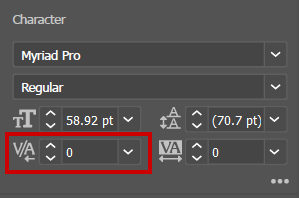
2. Add the command to the bounding box. "kern: optical"
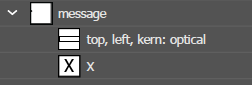
Changing the command to "kern: optical, ada" keeps the closest points of neighbouring letters at least a tenth of the letter height apart. Pairs that optical kerning would leave closer are opened to that minimum and the rest are unchanged
3. The resulting spacing will take character pairs into account. This spacing is very similar but not 100% identical to the optical kerning spacing found within Illustrator (which is proprietary).

Please note that uploading a custom kerning table for a font is not currently possible in SignAgent. Only optical kerning is available.